Electric cycle battery guide: Read the numbers before you buy
Understand electric cycle battery capacity, Ah, volts and Wh. Compare range claims, charging arrangements, compatibility and replacement support before buying.
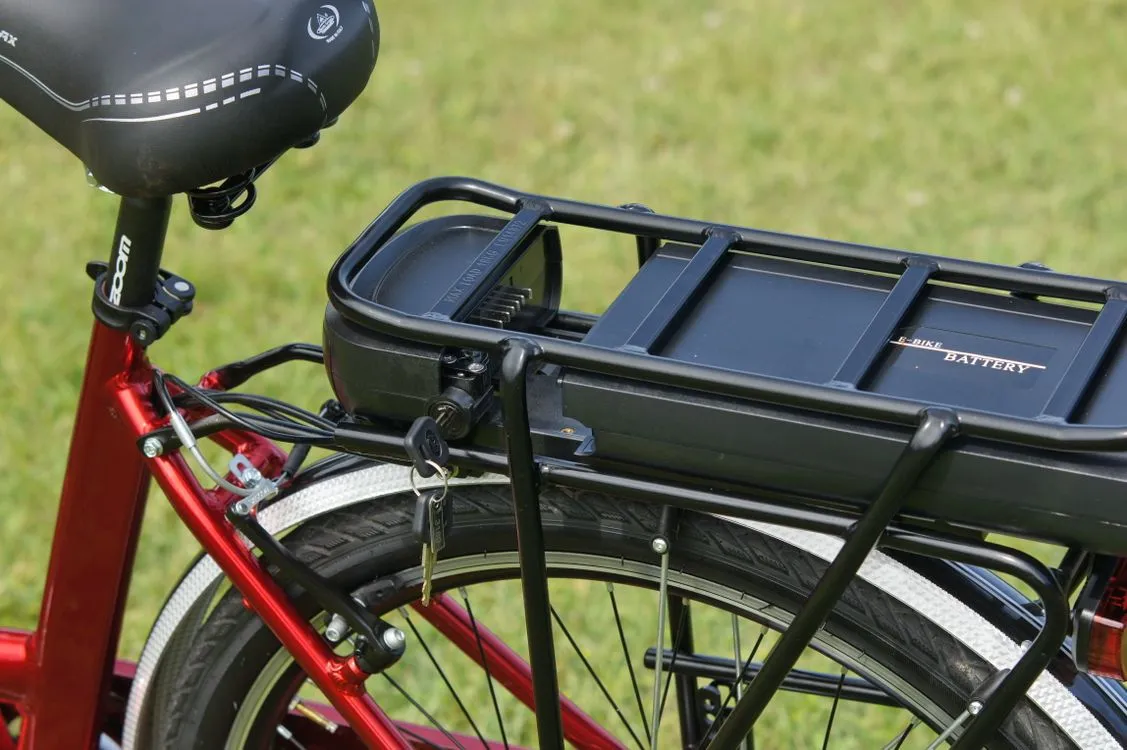
The battery usually gets one line on an electric cycle’s product page. The range gets a headline. Between the two lies much of what a buyer actually needs to know.
A pack marked 10 Ah can hold less energy than another marked 8 Ah. A bigger battery can be useful without making the cycle faster. And two riders can leave home with identical batteries and return with very different amounts of charge.
Choosing an electric cycle battery becomes easier when you separate four questions: how much energy it stores, whether it works safely with the cycle, how you will charge it, and what happens when it eventually needs replacing. Start there, before treating a distance claim as a promise.
The quick answer
Compare battery energy in watt-hours (Wh), rather than amp-hours (Ah) alone. Check that the battery and charger are approved for the cycle’s electrical system. Then choose enough capacity for your actual route, with spare charge for detours and harder riding conditions. Removability, replacement availability and the written warranty deserve as much attention as the range figure.
There is no battery capacity that suits every rider. A smaller pack may make sense for short rides and a cycle that must be carried upstairs. Longer journeys, more assistance and fewer charging opportunities can make additional capacity worthwhile.
Ah, volts and Wh: Three labels with different jobs
Amp-hours describe electrical charge capacity. Voltage is another part of the battery’s specification. Watt-hours describe the amount of energy stored. For a useful nominal comparison:
Watt-hours = nominal voltage × amp-hours.
Consider three hypothetical packs, not specifications for any particular product:
- A 36 V, 10 Ah battery: approximately 360 Wh.
- A 48 V, 8 Ah battery: approximately 384 Wh.
- A 36 V, 14 Ah battery: approximately 504 Wh.
The 8 Ah pack in this example holds more nominal energy than the 10 Ah pack because its voltage is higher. Comparing Ah alone would lead you in the wrong direction.
These calculations compare stated energy, not battery quality or compatibility. They do not tell you whether a pack can safely run your cycle. A 48 V battery is not a substitute for a 36 V battery simply because it fits in roughly the same space.
Also keep watts and watt-hours separate. Motor power is expressed in watts; battery energy is expressed in watt-hours. A motor’s watt rating does not tell you the battery’s capacity, and a 500 Wh battery is not a 500 W motor.
Why battery capacity does not equal a fixed range
The useful relationship is straightforward:
Estimated distance = usable battery energy ÷ energy used per kilometre.
The difficult part is knowing that second number. It changes with the ride. A hill, a headwind, frequent starts, additional luggage or a higher assistance setting can increase the work asked of the system. Tyre condition and pressure, riding speed and the rider’s own effort also matter. Battery age and temperature can affect the energy available.
A hypothetical calculation shows the effect. If a cycle had 360 Wh of usable energy and used 6 Wh per kilometre, the arithmetic would give 60 km. At 10 Wh per kilometre, the same energy would give 36 km. These are teaching examples, not typical consumption figures or a prediction for a particular cycle. A battery’s nominal label also need not equal the energy you can actually use on a ride.
This is why a range figure needs its conditions. Ask whether a quoted distance was measured with pedal assistance or another operating mode, on what terrain, with what load, and at which assistance setting. If those conditions are unavailable, treat the number as incomplete information.
For an unfamiliar cycle, a repeatable test on your own route is more useful than comparing isolated maximum-distance headlines. Record distance, assistance setting, load and remaining charge over several rides. Keep a margin rather than planning to arrive with an empty battery.
Choose for the return journey, not the attractive half of the commute
A morning test ride can flatter a battery. The rider is fresh, the route is short, and the shop may sit on flat ground. Your normal week may include a loaded return trip, an uphill final kilometre or a charging point that is sometimes unavailable.
Write down the longest trip you reasonably expect to make between reliable charges. Include both directions. Note the stretches where you will want more assistance, especially climbs and repeated starts. Then ask the seller to explain how the cycle’s stated range relates to those conditions.
Avoid buying precisely enough claimed range to cover precisely your usual distance. There is no universal reserve percentage that makes every route safe; the useful margin depends on the route, the cycle and your ability to finish without assistance. The point is to allow for variation rather than assume a new battery’s best-case performance will stay unchanged.
A larger battery can reduce charging frequency, but it can add weight, cost or bulk. If carrying the cycle is part of every journey, lift the actual cycle before deciding. A range upgrade that makes the stairs impractical may solve the wrong problem.
Removable or integrated: Think about where the charger will live
“Integrated” describes where a battery sits. It does not necessarily mean it is permanently fixed. Some frame-integrated packs can be removed; others require a different charging or service arrangement. Check the particular design.
A removable pack can be convenient when the cycle stays in shared parking and the socket is indoors. Before buying, try removing and reinstalling it. Can you reach the lock? Does the pack feel manageable? Can you confirm it is properly secured? Find out what happens if the key is lost.
For a battery that normally stays on the cycle, work through the charging location. You need a suitable dry place and a compatible charger, following the manufacturer’s instructions. Do not plan a charging arrangement that obstructs an exit or leaves cables across a walkway.
Mounting position matters too. A rack battery sits differently from a battery low in the frame. Test the complete cycle, particularly if you will carry luggage. Appearance alone tells you little about whether the arrangement suits your routine.
Replacement availability belongs in the buying decision
A battery is a wearing component. Its useful capacity can decline over time, even with sensible care. Before paying for a cycle, ask for the exact replacement battery reference, the current replacement route and the warranty terms in writing.
Useful questions include:
- Is a compatible replacement available through the manufacturer or an authorised service channel?
- What does the warranty cover, and what exclusions or capacity conditions apply?
- Does the battery have to be sent away for assessment?
- If a larger pack is offered later, is it explicitly approved for this model?
- Is the supplied charger included in the support and replacement process?
The connector is only one part of compatibility. Battery management electronics, voltage, mounting and the rest of the drive system also matter. A pack that slides into place or has a matching plug is not automatically safe to use.
Do not open, recell or modify a pack as a home repair. If it is damaged or behaving abnormally, stop using it and get instructions from the manufacturer or a qualified service provider. Replacement advice should come from someone who can identify the complete system, not a photograph of the plug.
Charging habits that are worth getting right
Use the charger approved for the battery and follow the model’s charging and storage instructions. Check for visible damage before charging and let a hot battery cool as directed by its maker. Keep the charging area dry, away from combustible material and clear of escape routes. Do not leave charging unattended.
Bosch’s battery guidance also advises disconnecting after charging and avoiding prolonged storage at very high or very low charge. Its recommended storage charge applies to its own products; use your battery manufacturer’s instructions rather than copying another brand’s percentage or temperature limits.
There is no reason to invent a universal charging ritual. The useful habits are more practical: the correct charger, a suitable place, regular checks and instructions you can actually follow at home.
A five-minute battery check before buying
Photograph the battery label and ask for the manual. Confirm the nominal voltage, Ah and Wh, or calculate the nominal Wh if both other figures are given. Check the charger reference against the cycle’s documentation. Try the removal mechanism if there is one. Ask for written range-test conditions and the replacement-battery process.
Finally, explain your route to the seller. “I ride 12 km each way, climb on the way home and cannot charge at work” is a more useful brief than “I want the longest range.” A good answer should connect the battery to that routine.
Questions riders ask
Is a higher-Ah battery always better?
Not on its own. Compare Wh as well as voltage, then consider compatibility, quality, weight and your route. A higher-Ah pack can add energy when other relevant specifications are comparable, but it must be approved for the system.
Will a larger battery make an electric cycle faster?
More stored energy primarily changes how much energy is available for riding. It does not by itself establish a higher assisted speed. The cycle’s motor, controller and operating limits are separate considerations.
Can I use a charger with the same plug?
A matching plug is insufficient evidence. Use a charger explicitly compatible with the battery and follow the manufacturer’s instructions. The wrong charger can create a safety risk.
Can I ride after the battery runs out?
Many electric cycles can be pedalled without motor assistance, but check the model. The weight and gearing may make that very different from the assisted ride. Try riding with assistance switched off before relying on it as your backup plan.
The right battery is the one that fits the whole journey: the distance, the stairs, the socket and the years after the first ride. Read the label, ask about the system, and make the range claim explain itself.
Sources
- Cycling UK, Guide to e-cycle batteries: battery energy, range variability, mounting and replacement compatibility.
- Bosch eBike Systems, Battery knowledge and 12 questions about the eBike battery: Ah, Wh and voltage; charging, damage checks and safe handling.
- Gazelle, Electric bicycle battery and range: battery configuration and range conditions.
- Cover photo: alex via Pexels, free Pexels licence. Example of a rack-mounted battery, not a tested product.